
Do not sell the framework#
Leaders rarely wake up wanting another goal-setting system.
They want fewer competing priorities. They want teams to understand what matters. They want earlier signals when progress is drifting. And they want ambition without turning every missed target into a performance trial.
That is the case for OKRs.
Do not begin with terminology, cadence or templates. Begin with the cost of the current system. If priorities are unclear, work fragments. If goals stay inside teams, coordination arrives late. If progress is reviewed only at the end, there is no time to learn.
Sell the organizational outcomes, not the letters O-K-R.
OKRs are useful when they change the quality of choices and conversations. They are not a cure for weak strategy, unclear ownership or leaders who will not make trade-offs.
Lead with four outcomes#
The source material behind this guide uses four of the benefits John Doerr describes as OKR “superpowers”: focus, alignment, tracking and stretching. The important move is to translate each one into a problem your organization already recognizes.
Focus and commitment
OKRs force a choice about what deserves disproportionate attention now. The value is not the list of goals. It is the permission to reduce attention elsewhere.
If everything remains a priority after the OKR conversation, the organization has documented its workload rather than created focus.
Ask: Which priorities are important enough that we will protect capacity for them?
Alignment and connection
Visible objectives help teams understand how their work connects to a shared outcome. That transparency can expose competing assumptions and cross-team dependencies before they become delivery surprises.
OKRs do not manage dependencies for you. They make the need for coordination harder to ignore.
Ask: Where are teams currently optimizing locally because the shared outcome is unclear?
Tracking and accountability
Regular check-ins create a place to inspect evidence, surface risk and adjust the plan. Accountability here should mean responsibility without blame: an endangered Key Result triggers a conversation, not a verdict.
Ask: How early do we learn that an important outcome is drifting, and what can we still change when we learn it?
Stretch and learning
An ambitious objective can encourage teams to test approaches they would otherwise dismiss. That only works when leaders distinguish an aspirational target from a promise and treat a miss as evidence to examine.
Ask: Where would a bolder outcome create useful experimentation rather than reckless pressure?
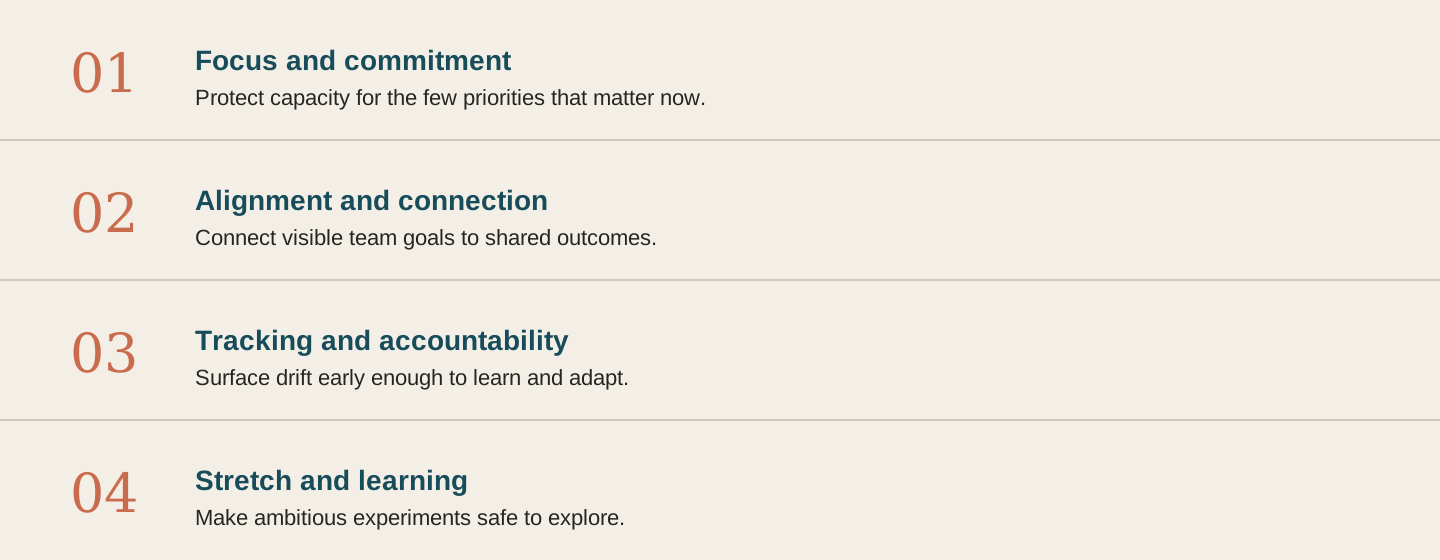
The language above is deliberately practical. A leadership team does not need to believe in “superpowers.” It needs to see how different working habits could improve decisions.
Start with the cost of staying the same#
A credible pitch names observable friction before proposing OKRs. Choose two or three signals, not a catalogue of complaints:
- Teams cannot name the top company priorities consistently.
- Roadmaps contain more commitments than available capacity.
- Dependencies surface after delivery has started.
- Status reporting describes activity, not movement in outcomes.
- Priorities change without a visible reason.
- Ambitious bets disappear behind business-as-usual work.
Use evidence you can show. A crowded portfolio, repeated escalations or contradictory team priorities are stronger than “we need more alignment.”
Then connect each cost to one desired behavior. For example: “We discover cross-team conflicts too late. A small set of visible outcome goals would give us an earlier coordination point.”
Make a smaller ask#
The hardest version of the pitch is “the whole company should adopt OKRs.” It asks leaders to approve a belief, a process and a large change at once.
Make the decision smaller and more testable.
Propose one cycle, one strategic area and a named group of leaders. Keep existing financial and operational metrics where they belong. Add only the few outcome goals that need special attention and a lightweight check-in rhythm.
Define what you want to learn:
- Did leaders make clearer priority trade-offs?
- Could teams explain how their work connected to the shared outcomes?
- Did check-ins surface risk early enough to change a decision?
- Did the cycle create useful ambition without punitive target management?
The pilot is not successful because every Key Result turns green. It is successful if the organization can make a better-informed decision about whether and how to continue.
Use this conversation#
Build the case in five moves:
- Current cost: “We are seeing these two recurring problems...”
- Desired behavior: “We need clearer trade-offs and earlier evidence of drift...”
- Why OKRs may help: “A few visible outcomes and regular check-ins could create those behaviors...”
- Bounded pilot: “Let us test one area for one cycle, without linking OKRs to compensation...”
- Decision rule: “At the end, we will inspect these signals and decide whether to adapt, stop or expand...”
This framing makes OKRs a hypothesis about better management behavior, not a fashionable destination.
Prepare for the obvious objections#
“This is another layer of process.”
It will be if OKRs sit on top of every existing priority. The pilot must replace or simplify part of the current goal conversation.
“Goals change too often here.”
Make assumptions and confidence visible. A changed decision can be healthy when the evidence and trade-off are explained.
“People will game the numbers.”
Keep learning goals separate from performance judgment. Combine metrics with qualitative evidence and never turn one KR into the whole story.
“We already have KPIs.”
Keep them. KPIs monitor system health. OKRs highlight the limited outcomes that need meaningful change now.
The pitch in one paragraph#
We do not need OKRs because other companies use them. We need a better way to make a few strategic priorities explicit, connect teams around outcomes and learn earlier when our bets are wrong. I propose a one-cycle pilot in one area, with no link to compensation. We will judge it by whether it improves trade-offs, coordination, learning and ambition - then decide whether to stop, adapt or expand.
Further reading#
John Doerr’s overview of OKR benefits describes focus, alignment, commitment, tracking and stretching. Use the benefits as a diagnostic lens, not as proof that OKRs are automatically right for your organization.