Writing
We built team autonomy with Legal
Shared limits grew team autonomy while Legal retained authority.
A marketing team I worked with brought some campaigns below 24 hours by building shared decision boundaries and preapprovals with Legal.
Why it matters: Repeated approval requests consume time on both sides. Shared criteria let the team handle familiar cases and reserve expert judgment for proposals that need it.
Where work got stuck: We were experimenting with communications about a regulated product. Legal and Compliance had to approve campaigns, and the company structure kept that authority outside the team.
A weekly session gave us reliable access to a lawyer. A campaign could still wait up to seven days for review. If the lawyer rejected part of an idea, people had to rethink the campaign while trying to secure approval in the same conversation.
Three decisions we learned to distinguish: We built tools with Legal as we worked, making its criteria usable earlier.
- No-no: reject or rework. A checklist helped the team discard or revise proposals that failed known checks before taking them to the lawyer. That reduced back-and-forth.
- Yes-no: seek expert review. The team could reshape an experiment’s scope and bring it back for assessment. Legal still judged the risk and made the approval decision.
- Yes-yes: use an agreed preapproval. Familiar campaign patterns could proceed within conditions already agreed with Legal. New or more complex experiments still needed expert review.
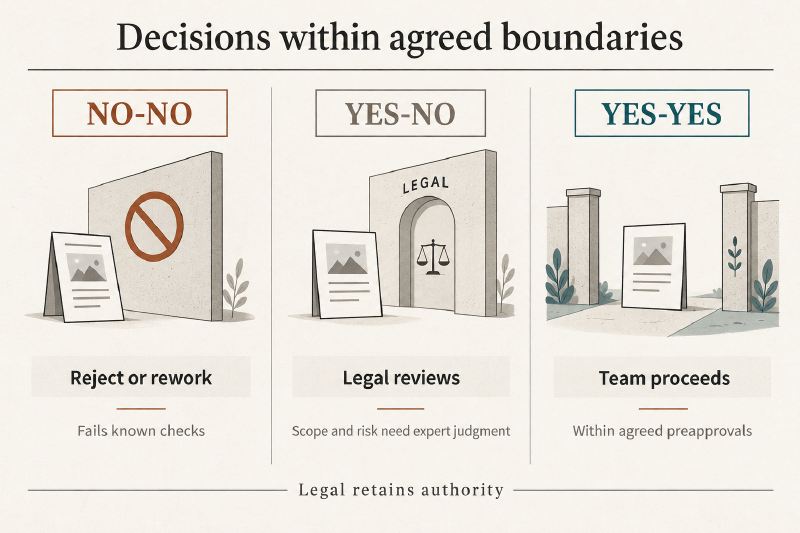
How the boundaries evolved: For illustration, imagine Legal rejecting a proposal to communicate a product feature to a broad audience. The team proposes a limited experiment with one specific segment, and the lawyer considers that revised experiment’s risk acceptable.
Changing the scope changes the proposal being assessed. It can move from “no-no” to “yes-no”, with Legal still deciding. My contribution was to help the marketing manager explore those conditions.
We kept turning what we learned into shared criteria and preapprovals. Legal retained its authority; the team gained more decisions it could handle within agreed boundaries. The lawyer could focus on cases that still needed expert judgment.
This was part of the protected-autonomy pilot. The under-24-hour result concerned some campaigns within that protected scope.
For your next recurring approval, ask the expert what the team could recognise earlier, which conditions would allow a preapproval, and when it should return for review. Does each review leave the team better equipped for the next decision?
If repeated approvals are slowing your team, let’s talk about one decision that keeps coming back.